During the Carboniferous period (359-299 million years ago), the area that is now the Finger Lakes was located near the equator and covered with dense tropical swamp forests. Giant dragonflies, millipedes, and predatory amphibians lived among trees that were as tall as modern ones but strange and primitive: seed ferns, giant horsetails, and strange scale trees with leaves growing directly out of their trunks.
Today, although the sharks and mangroves are gone, many of the lineages that first evolved in the Carboniferous are still endemic to our region, though much reduced in size. The majestic eagle-sized dragonflies and sofa-length millipedes have been replaced by more modest specimens, and horsetails and ferns now don’t grow much more than waist-high. The once-mighty scale trees have shrunk to the Lycopodiaceae, or clubmosses: a closer look reveals that these delicate little plants, often resembling conifer seedlings, are entirely covered by tiny leaves, just like their giant ancestors were. Their so-called “clubs” are strobili, or spore cases, which tend to resemble candles or cattails, though some species, such as the Shining Clubmoss (Huperzia lucidula), lack clubs altogether.
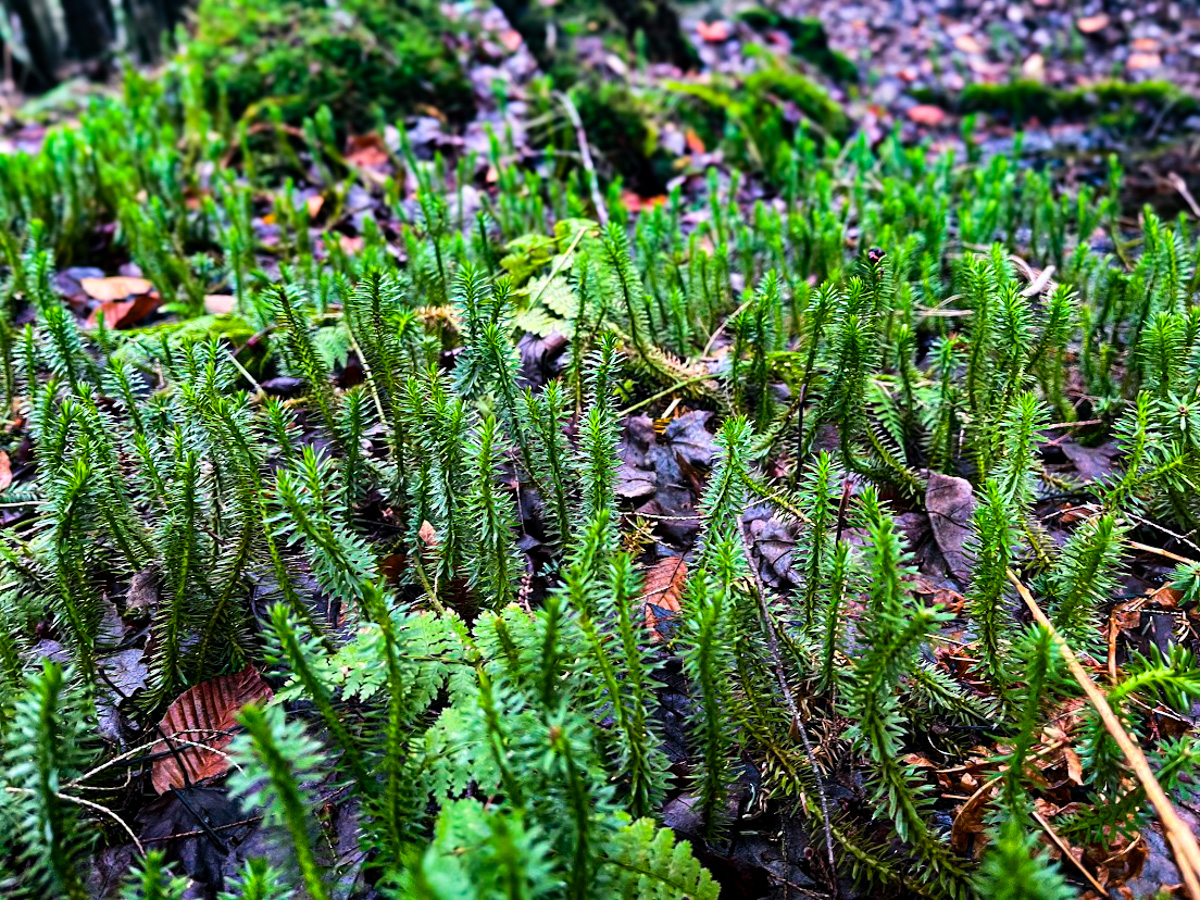
Huperzia lucidula (Shining Clubmoss)
Spores are not seeds: they contain only genetic material. Seeds, on the other hand, are complete packages, embryos supplied with food reserves. Clubmoss spores have a high-tech lipid coating that repels water very effectively, allowing them to travel on the wind and germinate only when the conditions are right. Native Americans and early colonists used these spores as dusting powder for babies; later, they were used to coat surgical equipment. Their high oil content makes them both highly lipophilic –they were used as a fingerprint powder – and highly flammable. When mixed with air and ignited, they produce spectacular fireballs, a property appreciated by Native shamans, early flash photographers, and stage magicians.
After the spores fall to the earth and are buried in soil, each one develops into a gametophyte or prothallus, a strange, fleshy organism that only survives if it forms a mycorrhizal relationship with a particular fungus. The fungus tunnels into its walls and feeds it digested organic matter like a mother bird feeding its nestling. This peculiar little pairing can remain underground for up to two decades until the prothallus develops both male and female organs. It fertilizes itself – unless another prothallus manages to sneak its own genes in – and a new clubmoss finally emerges from the soil.
These ancient plants live on the edge, in acidic and nutrient-poor habitats, the only places where they can compete for resources. Soils here tend to contain soluble, highly reactive aluminum, highly toxic to most species, but clubmosses are able to sequester it safely in their tissues. Since they grow slowly and rely on the presence of water, undisturbed soil, and friendly fungi, any environmental alterations – from reforestation to soil pollution to the loss of wetlands – can be disastrous: a third of the eleven species native to the Finger Lakes are vulnerable for one reason or another. Diphasiastrum complanatum, Northern ground cedar, has additionally been a victim of its own beauty. This species, endangered in New York State, grows in delicate clusters, all connected by one trailing runner: pull them up and you have a perfect holiday decoration, but one that may have taken several decades to mature.
Clubmosses aren’t defenseless, though their weaponry is often unsuited to the world that they find themselves in today. They produce potent alkaloids, chemical weapons that their ancestors evolved hundreds of millions of years ago to fend off the first terrestrial herbivores; nothing will touch them except starving deer, a few opossums, and some specialized slugs and snails. In large doses, alkaloids are poisonous, but in small doses, they can be medicinal, and Native Americans used club moss to treat many ailments. The aluminum that it contains makes the plant a very effective mordant, or dye-fixer, but its alkaloids can poison the unwary dyer.
Often used in bonsai, terraria, and crafts to recall the giant trees that they once were, it’s easy to regard the Lycopodiaceae as homey and harmless. Better to think of them as ancient and alien: bristling with poisons and metals, friends of fungi, resigned (I like to imagine) to living undercover on the fringes of a modern world.