Living Color in Clean, Cold Water: The natural history and conservation of native brook trout
In the shady highlands above the Finger Lakes, March snowmelt and April rains have charged our headwaters, filling the streams that lace the woods. If you pause on a sunny day and peer into these currents down to the gravel beds, you might spy a swirl of resistance against the flow, then a flare of motion and reflected light, then maybe even glints of brilliant orange, red, and blue. This is a brook trout – sleek and shimmering, vital and spectacular.
From a strict taxonomic standpoint, brook trout (Salvelinus fontinalis) are not actually trout at all, but rather char, which, like true trout, are in the family Salmonidae. Brook trout, along with lake trout (S. namaycush), are the only two native char of the Finger Lakes, and also the only native “trout” species in the colloquial sense.
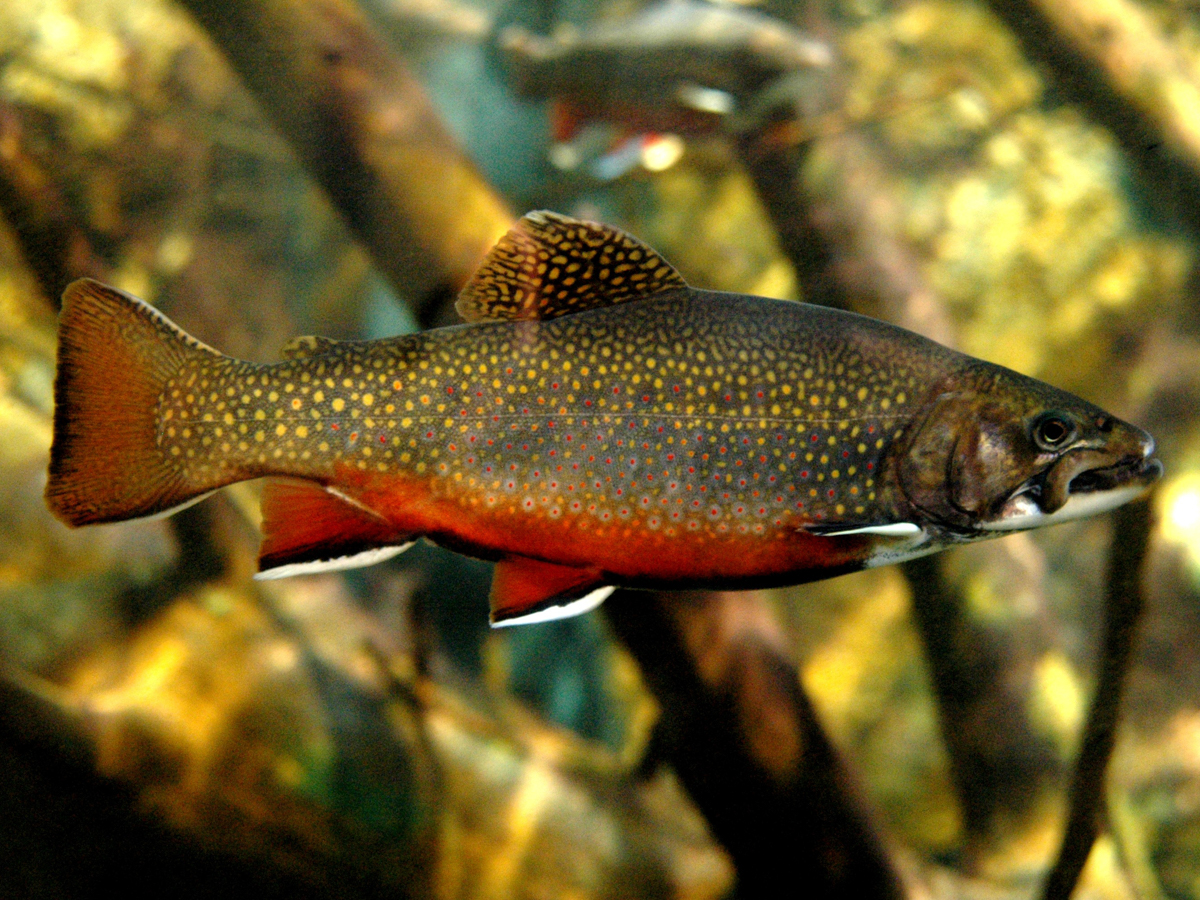
Photo: Bill Banaszewski
Enthusiasts love brook trout for their distinctive beauty. Along their sides, they have vivid red or orange spots often surrounded by blue rings. Their bellies are pale in the spring, deepening to an intense red during fall spawning (especially among males), with lower fins like pennants with bold swaths of white, black, and orange. All this bright color stands in contrast against their dark olive-brown backs. Here, a close look reveals a maze of irregular yet tidy lines called vermiculations. It doesn’t take too much imagination to discern a likeness between these markings and a map of their waterways, etched into a green landscape.
Brook trout live from the southern Appalachians to eastern Canada, with the Finger Lakes near the heart of this range. They require cold, clean water to thrive, ideally at temperatures holding between 52° and 60°F. The species lives primarily in upland headwater streams with clean, relatively silt-free gravel beds for spawning, as well as submerged boulders, fallen timber, and undercut banks for shelter and concealment. Under suitable water conditions, brook trout also live in secluded ponds and lakes. They wait out the winter in deeper, quiet pools in a state of reduced metabolic activity. Then in spring, they move to sun-warmed waters nearer the surface in search of prey. Brook trout have a broad diet – mostly aquatic insects and their larvae, as well as smaller fish, crustaceans, and even sometimes frogs and small rodents.
The New York State Department of Environmental Conservation (NYS DEC) lists brook trout as a Species of Greatest Conservation Need. They face many threats. Brook trout are sensitive to ecosystem changes resulting from deforestation, agriculture, and the reduction of connectivity of aquatic habitats. Introduced non-native fish, especially brown trout and rainbow trout, can outcompete brook trout for food and space, thus forcing them to move into poorer or more confined habitats.
Meanwhile, climate change can prompt a perilous rise in water temperature, leading to declining dissolved oxygen and, in turn, to metabolic stress, reduced feeding and growth, organ damage, and even death. Furthermore, insofar as climate change can trigger episodes of heavier rainfall and runoff, it can accelerate “browning” of streams (dissolution of organic matter), which traps more heat and dissipates still more dissolved oxygen, while also reducing visibility.
By the early 2000s, a study led by the U.S. Forest Service indicated that brook trout had been extirpated from 28 percent of native subwatersheds in the eastern United States, with populations reduced by half in an additional 35 percent. Thanks at least in part to conservation and restoration efforts, brook trout populations have apparently stabilized in New York in the past two decades, according to the DEC. Throughout this time, the Finger Lakes Land Trust has been doing its part – notably, in Owego Creek, upper Fall Creek in the Cayuga Lake watershed, and tributaries of the Cohocton River – by securing and connecting headwater corridors through conservation easements, cooperative acquisitions with the state of New York, and direct land acquisitions.
As a flick and a flash, as an image of connected and broken lines, and as an indicator of ecosystem health, brook trout are a living reflection of clean, cold, life-giving water. A glimpse of these fish is surely a consummate thrill. It’s also a reminder of their unguaranteed prospects. Protecting brook trout habitat is a mandate simple to state but hard to execute, requiring commitment and coordination amid a patchwork of human priorities and practices, from local to global scales.