The Finger Lakes Land Trust (FLLT) has purchased 108 acres in the town of Dryden, Tompkins County. The mostly wooded property borders Yellow Barn State Forest and is in close proximity to Hammond Hill State Forest and the FLLT’s Roy H. Park Preserve. With the protection of this parcel, the organization has reached a major milestone of 35,000 acres conserved across the Finger Lakes region.
The FLLT intends to transfer the parcel to New York State as an addition to Yellow Barn State Forest, a popular location for hiking, cross-country skiing, and other activities. Partnerships with the state are a key component of the FLLT’s efforts to expand public access to outdoor recreational opportunities while safeguarding water quality and wildlife habitat.
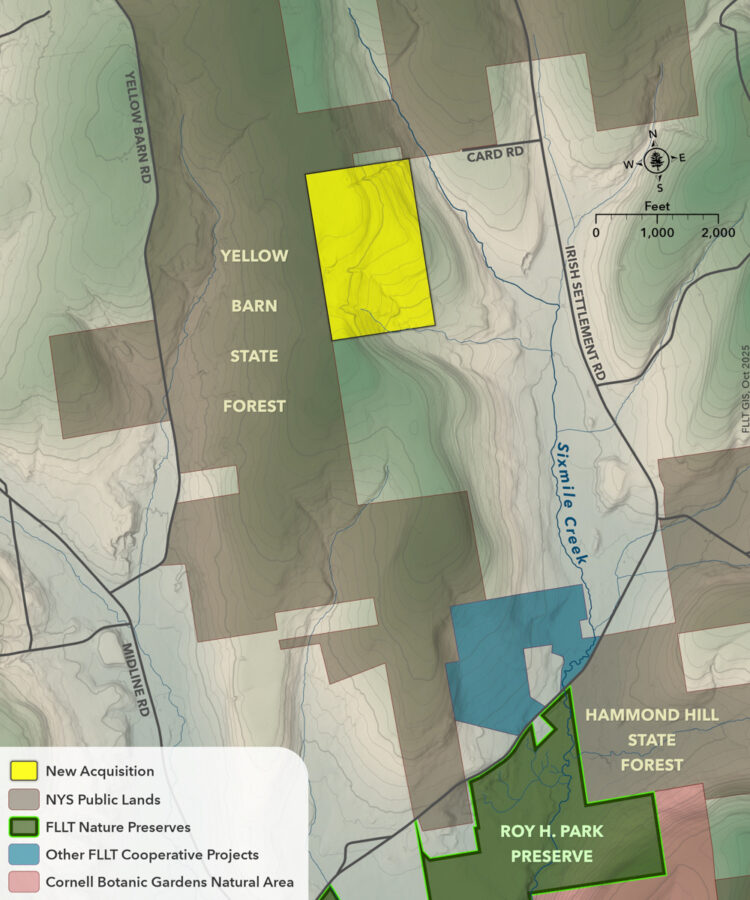
In addition to woodlands, the property contains a large pond and seasonal tributaries of Six Mile Creek, the source of drinking water for the city of Ithaca. It is also an important landscape connection piece in the Emerald Necklace, a growing complex of conservation lands.
The property was purchased from the adult children of Peter Van Soest, Professor Emeritus of Animal Science at Cornell University, who passed away in 2021. “Our father Peter Van Soest bought the ‘Hilltop’ land with friends in the early 1970s,” said John Van Soest. “It was their getaway for picnics and family swims. Eventually, he was the last owner. He wrote books there and held retreats with his students; it was a special place for him.”
The Emerald Necklace is a proposed greenbelt linking 50,000 acres of existing conservation land in an arc around Ithaca, from the Finger Lakes National Forest in the west to the Hammond Hill State Forest in the east. Together, these lands host 78 miles of the Finger Lakes Trail, two National Audubon Society-designated Important Bird Areas, numerous Finger Lakes Land Trust preserves and conservation easements, several state forests and parks, and dozens of Tompkins County-designated Unique Natural Areas. The Emerald Necklace is also recognized as a priority project within New York State’s Open Space Plan.
Funding for the project came from the FLLT’s Opportunity Fund, a dedicated account created by the organization to make time-sensitive acquisitions possible. Funds are ultimately replenished either through fundraising or the sale of land to a public conservation agency.